In my last entry, I talked about the unforgettable summer of 1970—and of course, much of that entry revolved around music. That's to be expected; music has been a vital part of my life, and I tend to measure my most memorable events by the music that I was enjoying at the time.
Before you dismiss the remainder of this post as the ramblings of a Luddite, let me mention that I have iPods. I have an iPod from every generation, in fact. I like iPods.
Now, back to the subject at hand.
Back in the 1960s, when I began buying albums (I made my first purchase in 1964--and it was, as you might have expected, Meet the Beatles), it was common for me to immerse myself in a new album. I played it over and over, learning the order of the songs, the transitions between tunes, the feel of each side of the album (usually, each side tended to convey a different mood, at least for me--and that determined which side became the A side as far as I was concerned). There was no shuffle, no random mixing; an album was a vital unit, and that's the way music was heard.
It didn't occur to me in those days that there were bad songs. I'd never dream of eliminating a song from an album; first off, it would be difficult to do so, since I'd have to get up, move the tone arm, and then reposition it for the next cut. But more importantly, it broke the organic flow of the album. Removing a song from an album would be like removing a note or a series of notes from an individual song because I didn't particularly like A-minor.
I hadn't realized just how important the flow of an album was until we recently acquired a 2006 Acura RL. It has a DVD-Audio player, so I transitioned much of my musical listening from my ever-present iPod to the DVD-Audio player. And then I rediscovered the allure of the album as opposed to the randomization of songs. Works were allowed to build on each other; moods were juxtaposed; I was once again hearing the unified work the way the artist envisioned it.
And as much as I enjoy my iPod, I realize that it's not the ultimate format for music. There's something to be said for the unified format of an album (even though they're not really albums at all any more), and I'm going to try giving more of my old favorites a new listen in an old-fashioned way.
Pardon me while I once again pull out a copy of Abbey Road and re-experience the Beatles' finale the way it was meant to be heard...
Tuesday, July 18, 2006


Wednesday, July 12, 2006
My Favorite Year
Does each of us have a "favorite year"? I do--or more specifically, I have a favorite part of a year. The summer of 1970...
That was the summer between my junior and senior year of high school. It seemed like an endless summer, probably due in large part to my taking a Summer Enrichment Program class at Berry College. This was a program they offered for select students from the various local high schools; we could take one college course at no charge, giving us educational opportunities that exceeded what was available to us in high school as well as offering a taste of college life. Since my chosen course, Calculus, was a morning class, I was getting up early (not a typical summertime activity for me) three days a week, which put me back home at 9:50 on those mornings, ready to enjoy the day.
I didn't have a job that summer, because of the SEP class; my parents didn't think it would be wise to balance the two. They suggested, wisely, that I focus on the class at Berry, since I had already accepted an academic scholarship there; it would probably have made them question the decision if I bombed out on the SEP course.
That meant that I had a full day of Doing Very Little--something that has turned out to be quite rare, although I had no idea that would be the case. My best friend at the time, Sven Ahlstrom had an afternoon newspaper route--a sprawling car route, not one of those neighborhood bicycle routes--so our days were typically spent riding around in his '68 Chevy Malibu, looking for comics or books or music, getting something to eat, then working his paper route. We were both doing fanzines--I was in two amateur press alliances and writing for other fanzines at the time, and I had lured Sven into the world of apa-dom as well--and that filled up some of our spare time. But the days seemed forever long, and the pressures seemed almost nonexistent.
Sven had an eight-track tape player in his car, for which we owned precious few tapes. What he and I had bought on eight-track, we listened to over and over again, Steppenwolf Live, Badfinger's Magic Christian Music, the Beatles' Let It Be, the eponymous Crosby, Stills, & Nash first album; In-a-Gadda-da-Vida, Chicago, Jesus Christ Superstar, the Rolling Stones' Beggars' Banquet... I know there were a few others, but not that many. Tapes were expensive, and for the most part they duplicated what we already owned on vinyl (albums were real music; tapes were just a means to enjoy that music on the road).
In those pre-iPod days, there was no shuffle; we listened to albums all the way through, again and again, until we not only knew every note of the song, but we knew exactly how long a silence there would be at the end, and then we knew every note of the song that would follow that. (Problem was, we had learned some of these playlists from the vinyl versions, and the eight-tracks were in different order so that they could divide the album into four more-or-less equal lengths--I could tell you why, but that's more eight-track technology than the 21st Century would dream of enduring.) So not only would we sing along with the songs that were playing, we'd start the next songs a half-beat or so before the music began--not because we mis-estimated, but because we were too impatient to wait.
Susan and I were dating, but she was working at the time, so I spoke with her only in the evenings and saw her only on weekends. Sven was interested in a friend of ours, Ida Hutchings, but any romance between them was sporadic and ill-fated; they were destined to remain friends, but nothing more. Gary Steele was a good friend, but for some reason he didn't enjoy the hours spent in an un-air-conditioned Malibu, so he rarely hit the road with us.
I feel like we lived in that Malibu; I didn't have a car of my own, although I could use the family's '64 Volkswagen if I really needed to, so Sven's car was our only legitimate transportation choice. Like all sixteen-year-olds with access to a car, we felt like it would be positively criminal not to drive as much as possible, so we were continually mobile.
We discovered underground comics that summer when what would probably have qualified as a head shop opened in Rome; I never paid attention to the drug or lifestyle paraphernalia, but the books by Robert Crumb and Foolbert Sturgeon and Richard Corben and Vaugn Bode were endlessly fascinating. We also discovered Rolling Stone that summer; the magazine was relatively new to Rome readers, since I don't believe that the two magazine distributors in Rome carried it prior to that spring. The biweekly magazine joined our must-read list alongside comics and science fiction magazines and Doc Savage books and Playboy (sure, we looked at the pictures, but we really did read the articles--and we discussed them!).
The summer gradually transitioned into the beginning of our senior year of high school; none of us knew at the time that this would be the last summer we were all so free to enjoy life as we wished. But oh, what a wondrous two and a half months it was!..
That was the summer between my junior and senior year of high school. It seemed like an endless summer, probably due in large part to my taking a Summer Enrichment Program class at Berry College. This was a program they offered for select students from the various local high schools; we could take one college course at no charge, giving us educational opportunities that exceeded what was available to us in high school as well as offering a taste of college life. Since my chosen course, Calculus, was a morning class, I was getting up early (not a typical summertime activity for me) three days a week, which put me back home at 9:50 on those mornings, ready to enjoy the day.
I didn't have a job that summer, because of the SEP class; my parents didn't think it would be wise to balance the two. They suggested, wisely, that I focus on the class at Berry, since I had already accepted an academic scholarship there; it would probably have made them question the decision if I bombed out on the SEP course.
That meant that I had a full day of Doing Very Little--something that has turned out to be quite rare, although I had no idea that would be the case. My best friend at the time, Sven Ahlstrom had an afternoon newspaper route--a sprawling car route, not one of those neighborhood bicycle routes--so our days were typically spent riding around in his '68 Chevy Malibu, looking for comics or books or music, getting something to eat, then working his paper route. We were both doing fanzines--I was in two amateur press alliances and writing for other fanzines at the time, and I had lured Sven into the world of apa-dom as well--and that filled up some of our spare time. But the days seemed forever long, and the pressures seemed almost nonexistent.
Sven had an eight-track tape player in his car, for which we owned precious few tapes. What he and I had bought on eight-track, we listened to over and over again, Steppenwolf Live, Badfinger's Magic Christian Music, the Beatles' Let It Be, the eponymous Crosby, Stills, & Nash first album; In-a-Gadda-da-Vida, Chicago, Jesus Christ Superstar, the Rolling Stones' Beggars' Banquet... I know there were a few others, but not that many. Tapes were expensive, and for the most part they duplicated what we already owned on vinyl (albums were real music; tapes were just a means to enjoy that music on the road).
In those pre-iPod days, there was no shuffle; we listened to albums all the way through, again and again, until we not only knew every note of the song, but we knew exactly how long a silence there would be at the end, and then we knew every note of the song that would follow that. (Problem was, we had learned some of these playlists from the vinyl versions, and the eight-tracks were in different order so that they could divide the album into four more-or-less equal lengths--I could tell you why, but that's more eight-track technology than the 21st Century would dream of enduring.) So not only would we sing along with the songs that were playing, we'd start the next songs a half-beat or so before the music began--not because we mis-estimated, but because we were too impatient to wait.
Susan and I were dating, but she was working at the time, so I spoke with her only in the evenings and saw her only on weekends. Sven was interested in a friend of ours, Ida Hutchings, but any romance between them was sporadic and ill-fated; they were destined to remain friends, but nothing more. Gary Steele was a good friend, but for some reason he didn't enjoy the hours spent in an un-air-conditioned Malibu, so he rarely hit the road with us.
I feel like we lived in that Malibu; I didn't have a car of my own, although I could use the family's '64 Volkswagen if I really needed to, so Sven's car was our only legitimate transportation choice. Like all sixteen-year-olds with access to a car, we felt like it would be positively criminal not to drive as much as possible, so we were continually mobile.
We discovered underground comics that summer when what would probably have qualified as a head shop opened in Rome; I never paid attention to the drug or lifestyle paraphernalia, but the books by Robert Crumb and Foolbert Sturgeon and Richard Corben and Vaugn Bode were endlessly fascinating. We also discovered Rolling Stone that summer; the magazine was relatively new to Rome readers, since I don't believe that the two magazine distributors in Rome carried it prior to that spring. The biweekly magazine joined our must-read list alongside comics and science fiction magazines and Doc Savage books and Playboy (sure, we looked at the pictures, but we really did read the articles--and we discussed them!).
The summer gradually transitioned into the beginning of our senior year of high school; none of us knew at the time that this would be the last summer we were all so free to enjoy life as we wished. But oh, what a wondrous two and a half months it was!..
Monday, July 10, 2006
The Heart of the Matter
Tomorrow is my six-month cardiac checkup; I'm not expecting anything out of the ordinary, but that doesn't stop me from feeling a little bit apprehensive. As much as I like Dr. Mike, my cardiologist and long-time friend, I still get a little nervous; there are always those dark back-of-the-mind worries that he'll come in and say something like, "Remember all those repairs we did back in 2000? Well, they didn't last..."
Before I brood too much and stay awake all night, I'll at least go through the good things that came out of my heart attack and subsequent surgery:
(1) I lost 70 pounds and have kept it off (well, all but about five pounds that occasionally come back to visit until I send them packing again)
(2) I started exercising faithfully and found out that I really like it
(3) I began eating a lot of Caribbean grilled salmon and grilled tuna steaks and ended up liking both more than beef, which I've virtually eliminated from my diet
(4) I reconnected with the great outdoors, thanks to my twice-a-day-minimum walks
(5) After being forced to retire, I discovered that it's not absolutely necessary that I get up at 5:24 a.m. after all
(6) I got to know Lucky, Sable, Rudy, Sadie, Scarlett, Sandy, Toby, Laurel, Hardy, Chelsea, Chester, and the rest of the dogs who expect some attention every time I walk past their houses (I like dogs, although I don't like owning dogs, if that makes any sense)
(7) I shaved my beard off and decided that, for the first time in years, I liked what was under it enough that I kept it shaved off this time
I know there are other things I should add to that list, but it's late and I actually do have to get up early tomorrow morning (have to exercise and feed cats prior to my 9 a.m. appointment)...
Before I brood too much and stay awake all night, I'll at least go through the good things that came out of my heart attack and subsequent surgery:
(1) I lost 70 pounds and have kept it off (well, all but about five pounds that occasionally come back to visit until I send them packing again)
(2) I started exercising faithfully and found out that I really like it
(3) I began eating a lot of Caribbean grilled salmon and grilled tuna steaks and ended up liking both more than beef, which I've virtually eliminated from my diet
(4) I reconnected with the great outdoors, thanks to my twice-a-day-minimum walks
(5) After being forced to retire, I discovered that it's not absolutely necessary that I get up at 5:24 a.m. after all
(6) I got to know Lucky, Sable, Rudy, Sadie, Scarlett, Sandy, Toby, Laurel, Hardy, Chelsea, Chester, and the rest of the dogs who expect some attention every time I walk past their houses (I like dogs, although I don't like owning dogs, if that makes any sense)
(7) I shaved my beard off and decided that, for the first time in years, I liked what was under it enough that I kept it shaved off this time
I know there are other things I should add to that list, but it's late and I actually do have to get up early tomorrow morning (have to exercise and feed cats prior to my 9 a.m. appointment)...
Dead Wooden
Last season, Deadwood shone, thanks to complex plotlines and eloquently quaint dialogue. This year, though, David Milch has taken everything that made Deadwood distinctive and pushed it to the point of excess: plotlines that meander with inadequate resolution, dialogue that is so pointlessly turgid that it impedes the flow of the story, characterization that seems at times at odds with itself...
When I first heard that HBO wasn't renewing this series for a fourth season, I was aggravated and disappointed. Now, though, I suspect they watched some of the season three episodes and realized that the spark was gone.
I'll stick around for the remainder of the season--but bear in mind that I also watched Twin Peaks and X-Files until the very end, even though both of those were execrable in their final seasons. My viewing is sometimes driven as much by loyalty as it is by a quest for quality...
When I first heard that HBO wasn't renewing this series for a fourth season, I was aggravated and disappointed. Now, though, I suspect they watched some of the season three episodes and realized that the spark was gone.
I'll stick around for the remainder of the season--but bear in mind that I also watched Twin Peaks and X-Files until the very end, even though both of those were execrable in their final seasons. My viewing is sometimes driven as much by loyalty as it is by a quest for quality...
Tuesday, July 04, 2006
Unconventional Times
I see today that Swiss authorities have criticized Israel for its actions in Gaza, claiming that it wasn't taking adequate steps to protect civilians and that it was utilizing collective punishment against the Palestinians.
It's obvious from recent developments like this and the absurd Supreme Court decision endowing Geneva Convention protections on terrorists that methods of warfare have changed to such an extent that the Geneva Convention must be modified, if not dismissed entirely.
The simple truth is, it's only the civilized Western societies that are allowing themselves to be limited by this. Switzerland wouldn't think of condemning the Palestinian terrorists for violating the conventions by allowing their "troops" to operate out of uniform, or for placing their "troops" and military installations in civilian areas, where they use civilians and particularly children as human shields. Why does Switzerland not condemn this? Simply put, it's because the civilized world doesn't expect the Palestinians or other Muslim extremist societies to operate by rules of civilized warfare. We have lowered our expectations of behavior for one side of the war, and then condemn the opposing forces for adjusting their methods of warfare in the face of an unprincipled enemy.
Of course, the world will wail and lament if the Geneva Conventions are cast aside--but truthfully, they exist only as another weapon in the Muslim extremist arsenal, a weapon that they are utilizing against Israelis and Americans and Britons on a daily basis.
It's time to clarify that the Geneva Conventions do not apply to a force that does not place its troops in uniform; they do not apply to a force that views its populace as nothing more than human sandbags; and it does not apply to a force that uses human beings as hostages without regard for the same Geneva Conventions.
So long as one side is forced to wage a 21st century war using 20th century philosophies, there's little chance of a clear victory...
It's obvious from recent developments like this and the absurd Supreme Court decision endowing Geneva Convention protections on terrorists that methods of warfare have changed to such an extent that the Geneva Convention must be modified, if not dismissed entirely.
The simple truth is, it's only the civilized Western societies that are allowing themselves to be limited by this. Switzerland wouldn't think of condemning the Palestinian terrorists for violating the conventions by allowing their "troops" to operate out of uniform, or for placing their "troops" and military installations in civilian areas, where they use civilians and particularly children as human shields. Why does Switzerland not condemn this? Simply put, it's because the civilized world doesn't expect the Palestinians or other Muslim extremist societies to operate by rules of civilized warfare. We have lowered our expectations of behavior for one side of the war, and then condemn the opposing forces for adjusting their methods of warfare in the face of an unprincipled enemy.
Of course, the world will wail and lament if the Geneva Conventions are cast aside--but truthfully, they exist only as another weapon in the Muslim extremist arsenal, a weapon that they are utilizing against Israelis and Americans and Britons on a daily basis.
It's time to clarify that the Geneva Conventions do not apply to a force that does not place its troops in uniform; they do not apply to a force that views its populace as nothing more than human sandbags; and it does not apply to a force that uses human beings as hostages without regard for the same Geneva Conventions.
So long as one side is forced to wage a 21st century war using 20th century philosophies, there's little chance of a clear victory...
Thursday, June 29, 2006
Psalm 137
I read earlier this evening the sorrowful news that 18-year-old Eliahu Asheri was found dead in Gaza; this civilian, a student, was kidnapped by Palestinian barbarians (a phrase I find more and more redundant, based on Palestine's continued adulation of barbaric and inhuman behavior and its unwillingness to act as a civilized nation) and apparently was murdered within hours of his seizure, in spite of Palestinian lies that he would be released if certain unreasonable demands were met.
Israel is moving troops into Gaza. At this point, I think that the world has been shown that Palestine is incapable of functioning as a legitimate national entity, and every withdrawal Israel has made thus far has been met with murderous hatred rather than efforts for peaceful coexistence. I applaud Israel for prompt action, and hope that they make Gaza, Rafah--and eventually all of the land held by the Palestinians--a permanent part of Israel.
Palestine was given a chance to show that it could function as a legitimate nation; they have proven that they lack the skills and the willingness to function as such, though, so it's time to withdraw the offer.
Israel is moving troops into Gaza. At this point, I think that the world has been shown that Palestine is incapable of functioning as a legitimate national entity, and every withdrawal Israel has made thus far has been met with murderous hatred rather than efforts for peaceful coexistence. I applaud Israel for prompt action, and hope that they make Gaza, Rafah--and eventually all of the land held by the Palestinians--a permanent part of Israel.
Palestine was given a chance to show that it could function as a legitimate nation; they have proven that they lack the skills and the willingness to function as such, though, so it's time to withdraw the offer.
Sunday, June 18, 2006
Thanks, Dad
I loved The Dick Van Dyke Show when I was younger; in some ways, it reminded me of my own childhood. Rob Petrie was a writer (for a television show); my dad was a writer (for a newspaper). Lora Petrie was a slender, graceful, beautiful woman, as was my mother. Rob Petrie was in the service, as was my father. The Petries lived in a relatively modern, albeit not overly spacious, suburban home; same for us. The Petries were sometimes troubled with financial worries, but they seemed to get by without to many financial woes; we did likewise, although I now know that our financial comfort came much more from my parents' prudence than it did from any surplus of funds. And the Petries' home was filled with happiness and laughter, as was ours.
In retrospect, I can recognize the differences between our family life and that of the Petries--but I still have a nostalgic love for The Dick Van Dyke Show, and I still feel that I see fragments of my own life in that series.
Dad gave me my appreciation of words and wordcraft, even though he was never much of a reader. I'm told I took that habit from my grandfather on my mother's side; I still credit my father for that, though, because I began reading the paper at an early age to see the words that my father created. I enjoyed watching him hammering on the keys of an old Royal, back in the pre-computer days; it was almost magical, watching words spring from my father's mind into inky existence, and seeing them go from there to typesetting and production, whereupon they'd appear in the next afternoon's newspaper. (Dad was a sports editor, so much of his work was done at night, when many of the high school games were played; this meant many late nights at the Rome News-Tribune, and I'd often spend some of those nights with him, rummaging about the busy newsroom, poring over old papers, and studying the walls that were decorated with original comic strip art supplied by the syndicates.
I learned to type almost as soon as I learned to write, because I saw typing as the way that real words were created. Dad didn't handwrite, he typed... and so did I.
While sports writing required Dad to be away from hom many weekend evenings, there was an advantage to it; the paper came out in the afternoon, so deadlines came early in the morning. This meant that Dad's schedule often allowed him to come home soon after I got out of school. I have fond memories of afternoons spent with Mom, Dad, and Kim as we watched Mike Douglas, Merv Griffin, You Don't Say, or The Match Game on television, followed by dinner at the kitchen table (we never had a dining room, which is probably why I never think to use ours for meals; family dinners are best when eaten in the same room where they're prepared). For the longest time, I had no idea that other kids' dads didn't get home at 3:30 or 4 in the afternoon, nor did I reailze that other families didn't eat dinner at 4:30 or 5:00. We did so regularly, and it was the model by which I measured normalcy in other families.
I can see now that I was blessed with an almost idyllic childhood, far moreso than many of my friends who grew up alongside me in the 1960s. I didn't realize it, of course, because children rarely consider such things; we take them for granted, and assume that everyone else had the same sort of life. I now know better, and I thank my Dad for giving me a childhood better than any television show.
In retrospect, I can recognize the differences between our family life and that of the Petries--but I still have a nostalgic love for The Dick Van Dyke Show, and I still feel that I see fragments of my own life in that series.
Dad gave me my appreciation of words and wordcraft, even though he was never much of a reader. I'm told I took that habit from my grandfather on my mother's side; I still credit my father for that, though, because I began reading the paper at an early age to see the words that my father created. I enjoyed watching him hammering on the keys of an old Royal, back in the pre-computer days; it was almost magical, watching words spring from my father's mind into inky existence, and seeing them go from there to typesetting and production, whereupon they'd appear in the next afternoon's newspaper. (Dad was a sports editor, so much of his work was done at night, when many of the high school games were played; this meant many late nights at the Rome News-Tribune, and I'd often spend some of those nights with him, rummaging about the busy newsroom, poring over old papers, and studying the walls that were decorated with original comic strip art supplied by the syndicates.
I learned to type almost as soon as I learned to write, because I saw typing as the way that real words were created. Dad didn't handwrite, he typed... and so did I.
While sports writing required Dad to be away from hom many weekend evenings, there was an advantage to it; the paper came out in the afternoon, so deadlines came early in the morning. This meant that Dad's schedule often allowed him to come home soon after I got out of school. I have fond memories of afternoons spent with Mom, Dad, and Kim as we watched Mike Douglas, Merv Griffin, You Don't Say, or The Match Game on television, followed by dinner at the kitchen table (we never had a dining room, which is probably why I never think to use ours for meals; family dinners are best when eaten in the same room where they're prepared). For the longest time, I had no idea that other kids' dads didn't get home at 3:30 or 4 in the afternoon, nor did I reailze that other families didn't eat dinner at 4:30 or 5:00. We did so regularly, and it was the model by which I measured normalcy in other families.
I can see now that I was blessed with an almost idyllic childhood, far moreso than many of my friends who grew up alongside me in the 1960s. I didn't realize it, of course, because children rarely consider such things; we take them for granted, and assume that everyone else had the same sort of life. I now know better, and I thank my Dad for giving me a childhood better than any television show.
Tuesday, June 13, 2006
Have You Ever Seen the Rain?
The newspapers are beginning to issue shrill warnings about our looming drought.
I'd take them a bit more seriously if (a) we hadn't had at least 10" surplus rainfall for each of the past two years, and (b) we were more than 3" below average rainfall for the first six months of this year.
Metro Atlanta's problem isn't a lack of rain--if you look at the three-year period, we're about a foot and a half above average--but the absolute inability of Atlanta to implement a meaningful and effective water control program to make use of the copious quantities of rain we receive.
Our average rainfall is just a tad more than 55" per year; that's just over four and a half feet of rain each year. An adequate reservoir and rainwater retention system should be ample to meet the needs of the growing metro Atlanta community without any problem--but that would require that someone actually plan ahead and require builders to contribute to the establishment of a water supply solution.
So as of now, we're seeing a lot of outdoor-watering bans, and there are talks of other water restrictions. Yeah, it's a horrible problem--we've had only 175"+ of rain since January of 2004. Life in the great Southeastern desert is pretty rough...
I'd take them a bit more seriously if (a) we hadn't had at least 10" surplus rainfall for each of the past two years, and (b) we were more than 3" below average rainfall for the first six months of this year.
Metro Atlanta's problem isn't a lack of rain--if you look at the three-year period, we're about a foot and a half above average--but the absolute inability of Atlanta to implement a meaningful and effective water control program to make use of the copious quantities of rain we receive.
Our average rainfall is just a tad more than 55" per year; that's just over four and a half feet of rain each year. An adequate reservoir and rainwater retention system should be ample to meet the needs of the growing metro Atlanta community without any problem--but that would require that someone actually plan ahead and require builders to contribute to the establishment of a water supply solution.
So as of now, we're seeing a lot of outdoor-watering bans, and there are talks of other water restrictions. Yeah, it's a horrible problem--we've had only 175"+ of rain since January of 2004. Life in the great Southeastern desert is pretty rough...
Civil Action
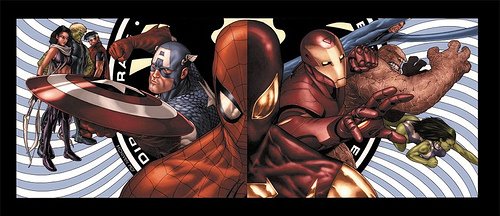 After totally missing the mark with last year's House of M, Marvel is finally doing the "big event" right with Civil War.
Apparently, Marvel spent a lot of time analyzing what made DC's big events of the past two years--Identity Crisis and Infinite Crisis--so successful, and they're implementing their findings with this mega-event. It establishes a gravitas right off the bat, and then delivers a complex plot that conveys a seriousness and scope in keeping with that gravitas.
The big event that is the catalyst for this storyline is the Superhero Registration Act. In the aftermath of a superhero disaster that led to the deaths of hundreds of civilians (many of them children), the government has pushed to register all super-powered beings. Some heroes, recognizing the responsibilities inherent in wielding massive powers in a public venue, support the plan; others, fearful of government control and politicization of the superhero community, oppose it. And that's the Civil War that the title refers to.
The first issue was simply stunning--as powerful as the first Identity Crisis, in fact, which is saying a great deal. But first issues are sometimes misleading--the first House of M was promising before it became evident that there was no more story to be told until the final issue, leaving readers wondering why it was a seven-issue series rather than two--so I waited to see Civil War #2 before making any decisions as to the quality of the series.
Civil War #2 was every bit as powerful as that first issue. The book builds to an amazing, Marvel-Universe-changing revelation in the final pages, but it's not the revelation that makes the book so good; it's the feeling that Important Things are happening in every issue. If Marvel can maintain this sense of great significance while delivering a compelling story, then this is the crossover series that Marvel fans have dreamed about.
I'm on board for the whole series--and I suspect that Civil War #3 will be the first book I pick up a month from now when it is released. I truly want to see what happens next, and that's the truest proof of a storyteller's success.
Saturday, June 03, 2006
From a Window
This morning was one of those rare June gifts: it was 64 degrees when I got up to go walking. After several days with lows in the 70s and highs in the upper 80s (we have yet to reach 90 degrees this year, in spite of the fact that the Atlanta weather reports indicate three days in the 90s already... I guess we're just lucky), a breezy 64 degree morning seemed almost cool.
After I finished my walk, did my weights routine, and ate breakfast, Anna and Mischa persuaded me, through longing looks and softly voiced protestations, to open the windows in the kitchen so that they could sit in the windowsills and look out. We began doing this in the spring, when the mornings were cool and we could do this without raising the indoor temperature or humidity. We had to discontinue the habit as the summer weather arrived, though, and they haven't been thrilled with the end of the window habit. Tisha, who's been with us for many more years (she's 17 now), is well past her open-window-fascination phase, so two open windows are usually adequate to create a happy-cat home.
When I went upstairs to check e-mail, I decided on a whim to open the upstairs family room window as well. Our yard slopes downhill in the back of the house, so the basement is at ground level in the back, making the upstairs three floors up. Over the years, the stand of tulip poplars and sweetgum trees has grown to such an extent that we seem to be ensconced among the upper limbs of the taller trees (one has spread its limbs to within a foot of the house, in fact); this creates a natural shade in the summer that makes the open window more appealing than it was when we first moved in. In those early years here, the open blinds and window would let in full morning and early afternoon sun; combine that with a then-inadequate air conditioning system upstairs, and the result would be a hot, humid upper floor that wouldn't get comfortably cool until well after midnight.
I opened the window, and was immediately struck by the pleasantness of the sound. The heavy canopy of leaves one the multitude of small limbs creates an almost continual rustling whisper as the breezes drift through; they also servea to cushion other noises that might be otherwise intrusive, such as the distant sound of a lawn mower. What I hadn't noticed when the windows were closed was the almost continual sound of birds in the tree limbs. Our trees seem to offer safe haven for a multitude of birds, and their mixture of chirps and songs have such bucolic allure that I found them much more engaging than television or music.
Apparently Anna and Mischa felt the same way, because within five minutes both cats had left their downstairs windowsill perches to settle into the window sill, and then into the cat trees located near the window. This offered them a hitherto-unrealized view of the upper limbs and the birds and squirrels who make themselves at home there, as well as providing a captivating mix of new sounds and new smells as the breezes waxed and waned.
I grew up in a house that had only one air conditioner, a one-room unit built into the wall of the living room that maintained tolerable comfort in that room as well as the kitchen. As a result, I was accustomed to summers spent in a bedroom without air conditioning, which meant that open windows were a part of my early years. Our open windows carried the sounds of breezes and leaves and birds, but also the sounds of cars and children and dogs, since my bedroom was in the front corner of the house, facing Marchmont Drive. My friend Gary Steele had a bedroom in the back of the older house that his parents had lived in for twenty years when he and I first met; it was a house sheltered by enormous oaks, so direct sunlight rarely touched it. Our open windows here remind me more of Gary's windows, allowing the sounds of verdant summer into the house.
Another friend, John Ball, had a house just off a busy four-lane thoroughfare; his open windows brought in the continual sound of purposed, busy life speeding past, and the only natural sounds came from the overgrown privet that cut some of the ambient light from the Dairy Queen and the miniature golf course that bordered his yard. But even those sounds were soothing to an eleven-year-old; sometimes, late at night, I would listen to the cars and trucks and wonder who was driving them, and what drove them to be on the roads in the dark hours of the morning rather than at home asleep.
My cousin Frank had a bedroom in the back of his parents' house on Chester Street in Marietta; when I would spend a week with him in the summer, we would open the window that was just inches away from his bed, and I listened in fascination to the sounds that he had long since taken for granted. His house was cut into an even steeper incline, so that his back yard was terraced to create the illusion that his upstairs window was even higher. There were no trees or shrubs near his window, so the night air would bring the sound of traffic from Fairground Street, or from the distant Lockheed Plant several miles away, or from the Coca Cola bottling plant that seemed never to sleep. I would imagine that the Lockheed sounds came from another P-38 being readied for flight (that distinctive twin-tailboom aircraft was a wonder to me then), although I really knew that the days of the P-38 were long gone... but oh, what one can envision after midnight!
When Susan and I first married, we lived in a small three-room house in Cedartown that was hidden beneath a heavy stand of pines, with an enormous willow just next to our bedroom window. We had a small air conditioner in the window of the living room/kitchen area (a single room divided by a poorly constructed half-wall), but our bedroom had no such air conditioning. As a result, we would frequently open windows; alas, the sound of breezes are much less melliflous through pines, although I remember the rustling of the willow leaves. (That willow and I were enemies, however. I had climbed that tree when I was nine, during a visit to my grandmother, and had plummeted from its heights when a limb gave way, resulting in the most painful and serious broken arm I experienced in my childhood... a childhood marked by several broken bones, almost inevitably the result of falls from trees as they disagreed with me as to what heights a boy should strive for.) I would also hear the sound of traffic just fifty or sixty yards away on Highway 27--particularly tractor-trailer truck traffic, which rumbled by in the distance at all hours. And the trains--there were tracks less than a mile away, on the other side of Highway 27, and their doleful calls punctuated the night.
When we moved one house away to our larger 4 room Cedartown home (but each of the rooms was in turn significantly larger, and it had a screened-in porch as well), our bedroom was in the back corner of that house. The sounds of Highway 27 and of the trains were still there, but seemed more muted; perhaps that's because the small house in which we had previously lived stood directly behind that second house, serving to muffle some of the sounds coming from that direction. I remember more sounds from the privet and the junipers that separated our yard from the house next door.
When we moved to Marietta in 1977, we moved into an apartment with central air conditioning, and we never opened the windows. From there, we moved to our house at 6045 Sumit Wood Drive in Kennesaw, then to 2339 Milstead Circle in Marietta, and finally here on Carillon Crossing; each house offered its own controlled environment, and I fell out of the habit of opening windows. In a way, I regret that--but since both the Sumit Wood Drive and the Milstead Circle homes were located next to neighbors with loud, intrusive dogs, I doubt that the sounds would have been sufficiently appealing to offset the aggravation of nearby barking.
It's taken me ten years at this house to rediscover the allure of an open window. Now that I have, though, I think I find the sounds more appealing than do the cats--and I suspect I'll miss the open window more when summer's heat sets in for three months. Oh, but September isn't all that far away--and I suspect that autumn will offer a distinctive, even more sibilant euphony before the leaves at last let go of their tenuous golden grip...
After I finished my walk, did my weights routine, and ate breakfast, Anna and Mischa persuaded me, through longing looks and softly voiced protestations, to open the windows in the kitchen so that they could sit in the windowsills and look out. We began doing this in the spring, when the mornings were cool and we could do this without raising the indoor temperature or humidity. We had to discontinue the habit as the summer weather arrived, though, and they haven't been thrilled with the end of the window habit. Tisha, who's been with us for many more years (she's 17 now), is well past her open-window-fascination phase, so two open windows are usually adequate to create a happy-cat home.
When I went upstairs to check e-mail, I decided on a whim to open the upstairs family room window as well. Our yard slopes downhill in the back of the house, so the basement is at ground level in the back, making the upstairs three floors up. Over the years, the stand of tulip poplars and sweetgum trees has grown to such an extent that we seem to be ensconced among the upper limbs of the taller trees (one has spread its limbs to within a foot of the house, in fact); this creates a natural shade in the summer that makes the open window more appealing than it was when we first moved in. In those early years here, the open blinds and window would let in full morning and early afternoon sun; combine that with a then-inadequate air conditioning system upstairs, and the result would be a hot, humid upper floor that wouldn't get comfortably cool until well after midnight.
I opened the window, and was immediately struck by the pleasantness of the sound. The heavy canopy of leaves one the multitude of small limbs creates an almost continual rustling whisper as the breezes drift through; they also servea to cushion other noises that might be otherwise intrusive, such as the distant sound of a lawn mower. What I hadn't noticed when the windows were closed was the almost continual sound of birds in the tree limbs. Our trees seem to offer safe haven for a multitude of birds, and their mixture of chirps and songs have such bucolic allure that I found them much more engaging than television or music.
Apparently Anna and Mischa felt the same way, because within five minutes both cats had left their downstairs windowsill perches to settle into the window sill, and then into the cat trees located near the window. This offered them a hitherto-unrealized view of the upper limbs and the birds and squirrels who make themselves at home there, as well as providing a captivating mix of new sounds and new smells as the breezes waxed and waned.
I grew up in a house that had only one air conditioner, a one-room unit built into the wall of the living room that maintained tolerable comfort in that room as well as the kitchen. As a result, I was accustomed to summers spent in a bedroom without air conditioning, which meant that open windows were a part of my early years. Our open windows carried the sounds of breezes and leaves and birds, but also the sounds of cars and children and dogs, since my bedroom was in the front corner of the house, facing Marchmont Drive. My friend Gary Steele had a bedroom in the back of the older house that his parents had lived in for twenty years when he and I first met; it was a house sheltered by enormous oaks, so direct sunlight rarely touched it. Our open windows here remind me more of Gary's windows, allowing the sounds of verdant summer into the house.
Another friend, John Ball, had a house just off a busy four-lane thoroughfare; his open windows brought in the continual sound of purposed, busy life speeding past, and the only natural sounds came from the overgrown privet that cut some of the ambient light from the Dairy Queen and the miniature golf course that bordered his yard. But even those sounds were soothing to an eleven-year-old; sometimes, late at night, I would listen to the cars and trucks and wonder who was driving them, and what drove them to be on the roads in the dark hours of the morning rather than at home asleep.
My cousin Frank had a bedroom in the back of his parents' house on Chester Street in Marietta; when I would spend a week with him in the summer, we would open the window that was just inches away from his bed, and I listened in fascination to the sounds that he had long since taken for granted. His house was cut into an even steeper incline, so that his back yard was terraced to create the illusion that his upstairs window was even higher. There were no trees or shrubs near his window, so the night air would bring the sound of traffic from Fairground Street, or from the distant Lockheed Plant several miles away, or from the Coca Cola bottling plant that seemed never to sleep. I would imagine that the Lockheed sounds came from another P-38 being readied for flight (that distinctive twin-tailboom aircraft was a wonder to me then), although I really knew that the days of the P-38 were long gone... but oh, what one can envision after midnight!
When Susan and I first married, we lived in a small three-room house in Cedartown that was hidden beneath a heavy stand of pines, with an enormous willow just next to our bedroom window. We had a small air conditioner in the window of the living room/kitchen area (a single room divided by a poorly constructed half-wall), but our bedroom had no such air conditioning. As a result, we would frequently open windows; alas, the sound of breezes are much less melliflous through pines, although I remember the rustling of the willow leaves. (That willow and I were enemies, however. I had climbed that tree when I was nine, during a visit to my grandmother, and had plummeted from its heights when a limb gave way, resulting in the most painful and serious broken arm I experienced in my childhood... a childhood marked by several broken bones, almost inevitably the result of falls from trees as they disagreed with me as to what heights a boy should strive for.) I would also hear the sound of traffic just fifty or sixty yards away on Highway 27--particularly tractor-trailer truck traffic, which rumbled by in the distance at all hours. And the trains--there were tracks less than a mile away, on the other side of Highway 27, and their doleful calls punctuated the night.
When we moved one house away to our larger 4 room Cedartown home (but each of the rooms was in turn significantly larger, and it had a screened-in porch as well), our bedroom was in the back corner of that house. The sounds of Highway 27 and of the trains were still there, but seemed more muted; perhaps that's because the small house in which we had previously lived stood directly behind that second house, serving to muffle some of the sounds coming from that direction. I remember more sounds from the privet and the junipers that separated our yard from the house next door.
When we moved to Marietta in 1977, we moved into an apartment with central air conditioning, and we never opened the windows. From there, we moved to our house at 6045 Sumit Wood Drive in Kennesaw, then to 2339 Milstead Circle in Marietta, and finally here on Carillon Crossing; each house offered its own controlled environment, and I fell out of the habit of opening windows. In a way, I regret that--but since both the Sumit Wood Drive and the Milstead Circle homes were located next to neighbors with loud, intrusive dogs, I doubt that the sounds would have been sufficiently appealing to offset the aggravation of nearby barking.
It's taken me ten years at this house to rediscover the allure of an open window. Now that I have, though, I think I find the sounds more appealing than do the cats--and I suspect I'll miss the open window more when summer's heat sets in for three months. Oh, but September isn't all that far away--and I suspect that autumn will offer a distinctive, even more sibilant euphony before the leaves at last let go of their tenuous golden grip...
Subscribe to:
Posts (Atom)